


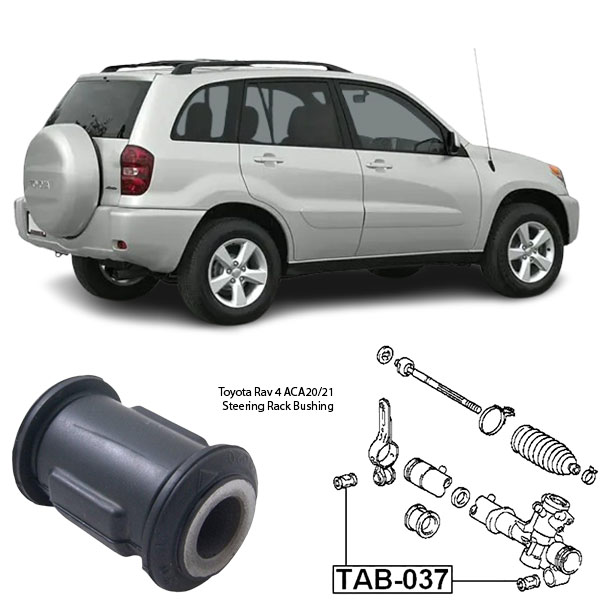

Get Toyota Rav 4 ACA20/21 Steering Rack Bushing TAB-037 in Kenya
When you think of smooth, precise control, the first parts that come to mind might be big and visible. But hiding beneath it all is something subtle, quiet, and incredibly important — the steering rack bushing. It may be small, but it plays a huge role in every turn, twist, and response from the wheel.
This humble component is the unsung hero that cushions and aligns your entire steering system — absorbing shock, reducing play, and giving you that confident, connected feel every time you move the wheel. 💡
What is a Steering Rack Bushing? 🔍
The steering rack bushing is a dense, often rubber or polyurethane component that sits between the steering rack and the chassis/frame. Its job? To keep everything in place while still allowing just enough movement to absorb vibration, pressure, and road input.
It doesn’t just hold the rack steady — it ensures that all steering inputs are delivered precisely and smoothly, without extra play or wandering. Without it, you’d feel every jolt, and steering would feel loose or uncertain.
What Does It Do? ⚙️
The steering rack bushing acts like a buffer and stabilizer between metal components. Here’s what it delivers:
-
Reduces vibration from the road 🛣️
-
Absorbs shock from steering forces 💥
-
Keeps the steering rack centered for consistent response 🎯
-
Minimizes wear between metal parts 🧰
-
Improves steering accuracy and feel every time you turn the wheel 🌀
It sounds simple, but its effect is immediate — especially when you switch from a worn bushing to a fresh one.
Types of Steering Rack Bushings 🧩
There are typically two main materials used:
-
Rubber Bushings
🟢 Common, cost-effective, and great at absorbing vibration.
🛑 May wear out faster under stress, especially with aggressive driving or heavy loads. -
Polyurethane Bushings
🔵 More durable and resistant to wear and heat.
🔧 Offers firmer support — better for responsiveness, though sometimes slightly harsher in feel.
Both have their place depending on what you value most: comfort, longevity, or performance.
Signs Your Steering Rack Bushing Needs Replacement ⚠️
Over time, bushings wear out due to constant motion, pressure, and environmental exposure. Here’s how to spot a tired bushing:
-
Clunking or knocking sounds during turns 🥴
-
Vague or “loose” steering feel — harder to stay straight 💫
-
Excess vibration in the steering wheel at speed
-
Steering pulls to one side or feels inconsistent 🌀
-
Visible cracks, wear, or sagging in the bushing material
If you’re feeling disconnected from the road or steering just isn’t as tight as it used to be, this small part could be the reason.
The Driving Experience: Before vs. After 🛞⚡
Let’s talk experience — because that’s where the magic of this component really shows.
Before Replacement:
-
Every little bump or groove gets translated into the wheel
-
Turning feels delayed, squishy, or vague
-
Constant micro-adjustments just to stay centered
-
Low-key stress every time you hit a pothole or uneven patch
After Replacement:
-
Smooth, controlled steering response 🎯
-
Sharper cornering feel — less “guesswork” at the wheel
-
Vibration dramatically reduced
-
A sense of calm and control that makes every journey smoother 🌟
It’s not just a fix — it’s a transformation. The kind that makes you fall in love with the feel of the road again.
Installation Matters 🔧🧠
Replacing the steering rack bushing requires precision and care. It’s not just about swapping one part for another — it involves:
-
Lifting and supporting the front end
-
Accessing tight spaces under the chassis
-
Unbolting the steering rack from its mounts
-
Pressing out the old bushing (sometimes seized in place)
-
Aligning and pressing in the new bushing correctly
Done right, the results are immediate. Done wrong, it can throw off alignment, cause binding, or lead to premature wear. That’s why this is one job best handled by experienced hands. 🧤
Longevity and Maintenance 🕰️
Once installed, a good-quality bushing — especially polyurethane — can last a long time. But environment and driving style play a big role:
-
Rough terrain, frequent bumps, and aggressive driving can wear it faster
-
Rubber bushings may dry out, crack, or shrink over time
-
Regular inspections help catch wear before it becomes a problem
You don’t need to service the bushing, but you do want to keep an eye on how the steering feels — your hands will usually be the first to notice something off. 👀
Why It Matters So Much 🤔
Here’s why this tiny part deserves big respect:
-
Every steering input passes through it. If it’s loose, worn, or cracked, the entire system becomes less responsive.
-
It connects you to the road. When it’s solid, you feel confident. When it’s failing, you’re constantly correcting.
-
It protects bigger components. By absorbing stress and reducing movement, it prevents wear on the rack itself, the tie rods, and even the column.
The Quiet Hero of Control 💬
So much of a good driving experience comes from unseen parts doing their job quietly and consistently. The steering rack bushing is one of those parts.
You may never see it. You might not even know it exists until it starts to go bad. But once you replace it, you’ll feel the difference instantly — in every lane change, every corner, and every moment your hands are on the wheel.
Small part. Big comfort. Huge control. That’s the power of the steering rack bushing.
Follow us on Facebook for more parts.
